phanaerozoic

Musings about life on Earth in all its aspects…

Category: Uncategorized

Sample Poems from “Music I Once Could Dance To”

My debut poetry book, “Music I Once Could Dance To” (ISBN-13 978-0-9795844-8-0, 6″ x 9″, 100 pp., $10), has been well received and we are on our second printing. It is published by Coal City Review and Press of Lawrence, Kansas. It contains an introduction by past Kansas Poet Laureate Caryn Mirriam-Goldberg.

I have made  a sample of three poems from the book available as a pdf file downloadable for free: (Click on the image of the musical notes).

Here is a link to a recent review (“Wichita poet’s debut collection is rich and resonant“) that contains excerpts of portions of other poems so you can get a better feel for the diversity of poems in the book.
If you find them of interest I would be so happy to have you buy a copy. The book is a steal at the price, is beautifully designed and printed in addition to containing poems that I hope may set you to singing or dancing. Check out the publisher’s web page HERE.

You can read more about the book’s origins and the process of getting it into print, photos from some recent readings, and other links at my Author’s Page.
Thanks!

Music I Once could Dance To- Front Cover

– Roy Beckemeyer

Music I Once Could Dance To: poems.
Roy J. Beckemeyer. 2014.
Introduction by Caryn Mirriam-Goldberg

ISBN-13 978-0-9795844-8-0
6″ x 9″, 100 pp., $10.

Available from Coal City Review and Press,
Brian Daldorph, Editor/Publisher
Lawrence, Kansas

What is Here That Has Been Here from the Beginning

Revi71+jBV7ZPbLew of the poetry book:

Autochthonous: Found in Place” by Dan Pohl with Illustrations by Jessie Pohl, 2014, ISBN 978-0985458669, Woodley Press, Topeka, Kansas

Dan Pohl’s “Autochthonous: Found in Place,” is a paean to his home state, Kansas, its inhabitants, his circle of family and friends.  True to its title, the book focuses on the sense of Place that characterizes poetry from the heartland at its best. Phrases like “explorers came when the stars looked younger,” and “…field / Stones, picked out to plow a good life,” bring us into the fold of those who made this prairie what we see today, gave it its names, showed us all the ways they had prepared it for us.  He offers advice and aid to those travelers who hurry through the wind-blown plains, never willing to take the time to see what one has to look a bit harder to find. In these pages he takes them by the hand, provides “the answer, hard enough to stamp lines / Onto the outside corners of their eyes.”  Oh, and what telling answers he gives, patient, generous, insightful in the wisdom he gleans from the everyday, the phenomenal, the rare, the commonplace.

With images of prairie dogs burrowing “deep into their Kansas seas…Centuries deep,” and haylofts as “the ship keel of / Trusses,” he invites us to see with new eyes what we thought we knew. He is not afraid to build with his words on the page not only a metaphorical image, but a graphic picture. In “The Rule,” a simple story/fable of “Children…Quickly learn to step / To the side  To climb the slope…for a softer / Smoother glide  For the common / Good,” we can hold the page an arm’s length away and see two columns of staggered word steps bounding either side of the clean sledding path  that runs down the center of the page. A brilliant example of “concrete” poetry at its most subtle and compelling.

The poetry here appeals to all the senses. “Saying Grace” enshrines home cooking and sends you to pulling pots out of the pantry looking for the deep fryer. After reading “Poet Elliott’s Advice…” we rush outside and put our ear to the corner light pole to share “its cark cello hum…a low-frequency Hindu ‘Om’.” In “Hidden Membership” we are made party to the secret life of a church’s folding chairs, and we feel their discomfort beneath our rumps as the meeting drones on.

It is with moments taken from familiar events of everyday life that Dan reveals his love for life and for his family. In “Feeding After Four,” he tires of shopping before his wife does, stops to watch fish in an aquarium, catches a pair of turtles feeding: “…his companion, who / Softly, tenderly, slides behind him / And slips her long slender neck / Under his left side near his heart. / She wedges under his jaw and pressures / Against his red-striped nose to snatch / His bit of bread as lovers often do.” He takes us, with those simple last four words, from the mundane to the sublime so quickly, so unexpectedly.

And occasionally Dan Pohl will take you further afield, to more exotic places, as well. Close your eyes and you are on a river steamer on the Niger: “The patient river rusted away / The name, each day the captain / Double drunk by noon” (from the poem “Fangs and Water at Kanthuri, 1890”). In “Lover’s Moment,” he writes: “I ride the bus to San Mida / The journey ends before me / I will run what I can / Though the wind will need to help / Raise your wish on Salida’s Hill.”

Below those words is a delicate pen and ink sketch of a kite dancing in the air. Scattered through the book are drawings by Dan’s daughter, Jessie. They embody her interpretation of her father’s words, show how those words float in her mind the way this kite floats in the sky. This book of poems is more than most: it contains a father’s words embellished and burnished to a brighter hue by his daughters sketches.

All in all, you could not do much better than to pick up a copy of this book, take it outside into the morning along with a steaming cup of coffee, and find yourself.

– Roy Beckemeyer

The Monastery’s Seven Hours

Matins, midnight’s bout of prayer,File:BritLibRoyal14CVIIFol006rMattParisSelfPort.jpg
by yawning monks kneeling there,
eyes half closed, or all the way,
hoping for the break of day.

Lauds‘ laudatory monks, alert,
warmed by the sun, all assert
their blessings, state them to and fro,
no need for rooster’s morning crow.

At Terce, thrice now the prayers have rung,
the blessings chanted, the psalms sung.
The monks, all now fully awake,
bellow their prayers for all our sakes.

Sext is when the monks all ask
blessings on these gifts, the tasks
of kitchen cooks. These monks, cowled,
just men like us whose stomachs growl.

None the hour after the lunch,
when eyes again, I have a hunch,
get heavy-lidded and partly close
against the sun’s bright pm glow.

At Vespers the candles are brightly lit
and day’s end comes to the pews to sit.
Monks ponder charity and bits of grace,
till contentment falls on each one’s face.

Compline marks the end of day,
“Now I lay me down,” they say
These monks, serene, now each has found
peace as the liturgical hours go ’round.

– Roy Beckemeyer, April, 2014

This poem was an exercise for a poetry workshop I am leading called “Poetry by Sevens,” in which we write poems inspired by some subjects typically grouped in sevens.  For example, the Seven Wonders of the Ancient World, the Seven Dwarves, the Seven Deadly Sins, etc.  This one used the Seven Hours of Liturgical Prayer.  I tried to think of monks as just men, not some sublime praying creatures.

The illustration is from Wikimedia Commons and is a self portrait of a 13th Century  Benedictine monk, Matthaeus Parisiensis.


Poetry Month American Cinquains

Poetry Month American Cinquains (A five-line poetic form in which lines 1 through 4 have 2, 4, 6, and 8 syllables, respectively, and line 5 has 2 syllables).

April 1 (inspired by a drive through the Flint Hills after prairie spring burns):

The green
already there,
woven among black ash
remnants, fiery tweed of renewed
prairie.

April 2 (inspired by a Kim Stafford reading at Watermark Books, a William Stafford Centennial event):

Passion
for poetry.
Might it be genetics?
Talent passed from father to son?
Perhaps.

April 3 (inspired by this also being Jazz Appreciation Month):

Triplets,
swing notes, two-four,
Dorian, Phrygian,
sevenths, ninths, elevenths, thirteenths.
It’s Jazz.

April 4 (inspired by the first thunderstorm of the spring):

Rumble
Out at the edge
Of hearing. The clearing
Of a storm’s throat, a stage whisper:
“Action!”

April 5:

Cursive.
Writing paper.
Pen. Letters. Elegance.
Illuminated manuscripts.
By Hand.

April 6:

A list
poem is always
fun but then there must be
some scheme or logic, rationale,
something…

April 7:
Cattails.
Corruscations.
Contretemps. Cavalcades.
Conditioning. Crepuscular.
C-words.

 April 8:

I’m a
container for
all that blood, corpuscles –
white and red – and plasma. The stuff
of life.

April 9:

old dogs
lying beneath
our feet breathing softly
what more could we need in old age
than this

April 10:

blossoms
perch in clusters
on pear trees like close friends
bees flit, flirt, hum as petals start
to fall

April 11:

Tax day
is a comin’
another check I’ll write
not enough deductions for a
refund

April 12:

Where the
heck are April’s
showers? Here comes young May,
looking to plant flowers. Too dry?
Bummer!

April 13:

A – P –
R – I – L – T –
H – I – R – T – E – E –
N – T – H – April Thirteenth –
Spelled!

April 14:

Tulips
catch snow, don’t scowl,
stand sturdy and strong, tall,
but think of Amsterdam in spring,
and yearn.

April 15:

promise
of blood red moon
old earth’s shadow once more
makes the moon’s visage dimly blush,
chagrined

April 16:

Texting
with an iPhone
takes patience, eyesight, small
fingers, I have learned – then again,
have I?

April 17:

On this
day in the past
Thornton Wilder was born.
Gairrison Keillor told us this
today.

April 18:

Friday.
On Calvary
Crucifixion and death.
God’s Friday, Pious Friday, Good
Friday.

April 19:

Doctors
have specialties
like gynecology,
cardiology. I prefer
GP’s.

April 20:

Easter
Mornings the sun
rises, brimming over
with forgiveness, atonement for
our sins.

April 21:

Flower.
Bloom intensely.
Color with abandon
Every day of every spring.
Flower!


When I Was Eight Years Old …

for Martin Richard

… a pressure cooker helped
to make sure the green beans
were still good to eat
when we plucked them from
the cellar shelf in the middle of winter,
and nails were used to hold up walls
and ladders to tree houses on high limbs,
and signs that said
“Lemonade – 5¢”…

– Roy Beckemeyer, April, 2013

Links to Some of My Poems that Can Be Found on the Web

Since I now have poems and/or bits of poems scattered around on a number of sites on the web, I decided to gather the links and post them here to them all in one place. (Note that web links often have really short lives, so if you want to have a record of your poetry as published on-line, you might want to try saving the web page to your computer. This can be done in either html form or if you have Adobe Acrobat, you can often save a nice version in pdf form.) I also have several blog entries here on phanaerozoic devoted to poems, so be sure and look them up as well. Just click the tag “Poetry” under “Categories” to see all my blog entries that include poems.

These are roughly in chronological order of posting to the web, and at the time of this posting to phanaerozoic, all are active links:

At my personal web site, windsofkansas.com, there is a page that links to a number of poems: http://www.windsofkansas.com/poems.html

The individual poems are:

“Picking (2)” (posted October 12, 2001)
http://www.windsofkansas.com/picking.html
“Alaskan Food Chain” (posted October 12, 2001)
http://www.windsofkansas.com/alaskan.html
“Trailside Ecology Lesson” (posted October 12, 2001)
http://www.windsofkansas.com/trailsid.html
“On the Prairie At Dawn” (posted October 12, 2001)
http://www.windsofkansas.com/onthepra.html
“Quail Dog” (posted October 12, 2001)
http://www.windsofkansas.com/quaildog.html
“Dragonflier” (posted October 12, 2001)
http://www.windsofkansas.com/drgnflyr.html
“Ode to Erpetogomphus lampropeltis ovipositing in a Gila River Riffle” (posted October 12, 2001)
http://www.windsofkansas.com/ode.html
“Rebirth: Thoughts on Observing Dragonfly Larvae” (posted October 12, 2001)
http://www.windsofkansas.com/rebirth.html
“A Fortnight into Autumn, Dreaming” (posted April 8, 1996)
http://www.windsofkansas.com/owl2.html

On Tom Mach’s Blog, “Prose and Verse World”

Five “Machadaiku” poems – a form invented by Tom (posted May 19, 2011):
http://tommach.tumblr.com/post/5635318540/machadaiku-poetry-another-contribution
“Impressionist” (posted May 22, 2011)
http://tommach.tumblr.com/post/5732611388/impressionist-a-poem-by-roy-beckemeyer

At Greg German’s “Kansas Poets” website (http://www.kansaspoets.com/index.htm):

“In Kansas to Stay”
http://www.kansaspoets.com/ks_poems/Kansas%20Poems%20-%20Page%205.htm

At the web site of Kansas Poet Laureate (2009-2013) Caryn Mirriam-Goldberg, “150 Kansas Poems,” I was fortunate to have four poems chosen, the first two for her “Begin Again: 150 Kansas Poems” project in honor of the Kansas Sesquicentennial, one for “To the Stars Through Difficulties: A Kansas Renga in 150 Voices,” and one as “Poem of the Week.”

The first three are cached at:
http://150kansaspoems.wordpress.com/tag/roy-j-beckemeyer/ and are:

“A Kansas Farmwife’s Snow Song” (posted November 19, 2011)

134. A Kansas Farmwife’s Snow Song


“We Discuss the Geomorphology of Life” (posted April 5, 2011)

43. We Discuss the Geomorphology of Life


and from the renga (untitled, posted Feb. 5, 2012):

14. To the Stars Through Difficulty: Roy J. Beckemeyer

The fourth is the poem of the week posted February 11, 2013:

“Kasantatieh”

Ka·Santatieh by Roy Beckemeyer

Films, Stories and Poems Exhibited at the Percolator (A Multi-media Art Venue in Lawrence, Kansas) – The Story of Chickens (http://rocketgrants.org/2012/03/07/call-for-submissions-3/) by Amber Hansen Exhibited March 30 – April 21, 2012. Posted by The Story of Chickens on July 7, 2012:

“A Five-Tanka Poem: Where Food Came From in the 1950’s” (posted July 7, 2012)
http://rocketgrants.org/2012/07/07/films-stories-and-poems-exhibited-at-the-percolator/#jp-carousel-4328

At The Journal of Kansas Civic Leadership, Julia Fabris McBride, Poetry Editor, Chris Green, Managing Editor, Wichita, KS,
(http://issuu.com/kansasleadershipcenter/docs/thejournal.issuu) published in November, 2012 issue, p. 104-105:

“Hope” (posted November, 2012) – use above link, open issue and page to poem near end of issue

At the web site of Lisa M. Hase-Jackson, “200 New Mexico Poems”
(http://200newmexicopoems.wordpress.com/), in honor of the New Mexico Centennial:

“A Day at White Sands” (#193, posted December 13, 2012):
http://200newmexicopoems.wordpress.com/category/roy-beckemeyer/

At the blog, “Zingara Poet,” edited by Lisa M. Hase-Jackson (http://zingarapoet.net/), the Poem of the Week for February 6, 2013:

“The Baltimore Catechism: Unrequited Love”

The Baltimore Catechism – Unrequited Love by Roy Beckemeyer


Untitled: “Is the harvest moon swollen…” Response to Zingara Poetry Prompt for January 18, 2013 (posted February 20, 2013)

Questions Poetry Prompt


Untitled: “morning light grazing fields…”: Response to Zingara Poetry Prompt for February 15, 2013 (posted February 19, 2013) Zingara Poetry Prompt for January 18, 2013 (posted February 20, 2013)

Friday Poetry Prompt


“You, Approaching”: Response to Zingara Poetry Prompt for February 22, 2013 (posted February 22, 2013)

Fun with Similes Poetry Prompt

At the web site: The Shine Journal – The Light Left Behind: Journeys Through Grief (http://www.theshinejournal.com/) (Added to this list on 26 April, 2013):

Three Poems: “To My Brother on the Anniversary of Our Father’s Death,” “Maggie,” and “Elegy for Our Father” (http://www.theshinejournal.com/beckemeyerroy.htm)

– Roy Beckemeyer, 16 April, 2013

ANTARCTIC JOURNAL – 1998 – DECEPTION ISLAND

In the Antarctic, krill, which means ‘whale food’ in Norwegian, sustain not only whales, but also penguins, seals, squid, fish, albatross, and other seabirds. These small, shrimp-like creatures represent the very cornerstone of the Antarctic ecosystem — processing the energy of the sun stored in phytoplankton (microscopic free-floating plants) and breeding by the thousands to provide an abundant source of nourishment for higher-order predators. Virtually all the larger animals of the Antarctic are either directly or indirectly dependent on krill.” – from Krill: Cornerstone of the Antarctic, PBS.org

From my journal:

“Chinstrap Penguins at Bailey Head stream up the slopes in a continuous river of movement: swirls of penguins, freshets of penguins, long sweeping arcs of penguins, occasional eddies of penguins that hesitate briefly before continuing on.

Chinstrap 1

I point the viewfinder of my video camera into this chaos of penguins, then zoom in to focus on a square meter of black sand. I can cope with this small patch, analyze it just as I would a fluid flow problem. Establish a fixed reference volume and measure what goes in, what goes out. Thirty-eight penguins pass through my little box in two minutes. That’s nineteen penguins per minute per meter. The penguin stream here is about six meters wide. One hundred and fourteen penguins per minute passing this point, flowing uphill, uphill. Uphill to the chicks.

I change experimental techniques. One can also study flowing fluids by tracking the path of individual particles within the flow. I pan the camera back to the source of penguins, the rolling swells at the beach. Catch a knot of penguins at the water’s edge. Choose one. Watch the swell sweep it up onto the beach. It stands erect and steps. Step, step, step. Halt. Shake. Joins the flow: step, step, step. The penguin particle traces a path, a penguin streamline, up the beach toward the colony.

At this time of day, the net flow of penguins is uphill. Occasionally individuals or small groups can be found bucking the tide, going down toward the sea. Perhaps one in forty, one in fifty. Also going down the hill is a small stream of fresh water. The sea below penguin colonies seems always to be tinted, muddy, reddish, murky with suspended sediments of earth and guano: guano dyed pink with krill colors, organic krill dyes.

krill

Krill fuel this system, provide the energy that pushes this flow of penguins uphill in defiance of gravity. Step, step, step. Each footstep like a meshing gear tooth in a machine. Lifting krill soup, krill stew. Kilocalories of krill being carried up in discrete penguin packets, levered up the hill step by step.

I first sit on the sand, then move to a rock further up the slope. I use my brain as a signal processor, filtering out the squawks, creaks and groans of penguin vocal cords. Filter out the rolling swish of water onto the beach. I focus on the background sound, the stepping sounds, the almost sibilant slapping of feet onto the ground. Step, step, step. The quiet, insistent background sound of energy going uphill, always uphill.

Chinstrap 2

I go with the flow. Climb the hill myself. The stream of penguins opens, parting to form a tear-drop shape of penguin-less space around me, as if I were a boulder in the stream. As I top the hill the stream begins to lose its identity, to diffuse, to disappear into the melee of the colony. Here raucous groups stand in the sun on the rounded slopes above the beach. Chicks beg for food, insistently pecking at adult bills. The chicks are of course the reason for all the commotion, all the movement, all the flowing river of black and white that stretches back across the sand into the distance. The penguins in the distance are barely distinguishable, but their rocking, pendulum-like motion looks like ripples on water, like the fine-grained capillary waves that dapple otherwise calm seas. Each roll, each bob represents a step. Step, step, step. Nearly countless feet taking nearly countless steps, right, left, right, left, a sound like light rainfall. As time passes and my memories of Antarctica fade, I know that it will be the memory of these soft sounds of penguins stepping slowly, steadily up the slopes of Bailey Head that will make this precious moment real for me once again.”

– Roy Beckemeyer, Deception Island, South Shetlands, January 31, 1998.

ANTARCTIC JOURNAL – 1998 – THE DRAKE PASSAGE

“I now belong to a higher cult of mortals, for I have seen the albatross!” – Robert Cushman Murphy, Logbook for Grace

From my journal:

“God seems to have graced some living things more abundantly than others. He was particularly generous to pelagic birds. Our days between Ushuaia and South Georgia on the open waters of the South Atlantic Sea provide ample evidence of this.

Storm Petrels are a case in point. They dash across the sea like frenzied ice skaters, like Bolshoi dancers. They stop in place and dap their toes into the water like ballerinas en pointe. They careen off again, rolling back and forth, back and forth. Watch them closely enough, long enough, with sure and agile enough tracking, and they will reveal their identity by way of their belly plumage: dark for Wilson’s, white with a black streak for Black-bellied.

Wilsons StormPetrel Photo Filtered

But it is the stiff-winged albatrosses that to me best reveal the sea birds’ special grace. The first species we encounter is the lovely Black-browed, with its snowy white head and stunning black stripe through the eye. These birds wheel and glide behind the ship showing off their natty black and white plumage from all angles. Later we see Light-mantled Sooty and Gray-headed Albatrosses as well, each with equally pretty plumage. They are much rarer than the seemingly ubiquitous Black-browed, however, and for that reason seem more precious.

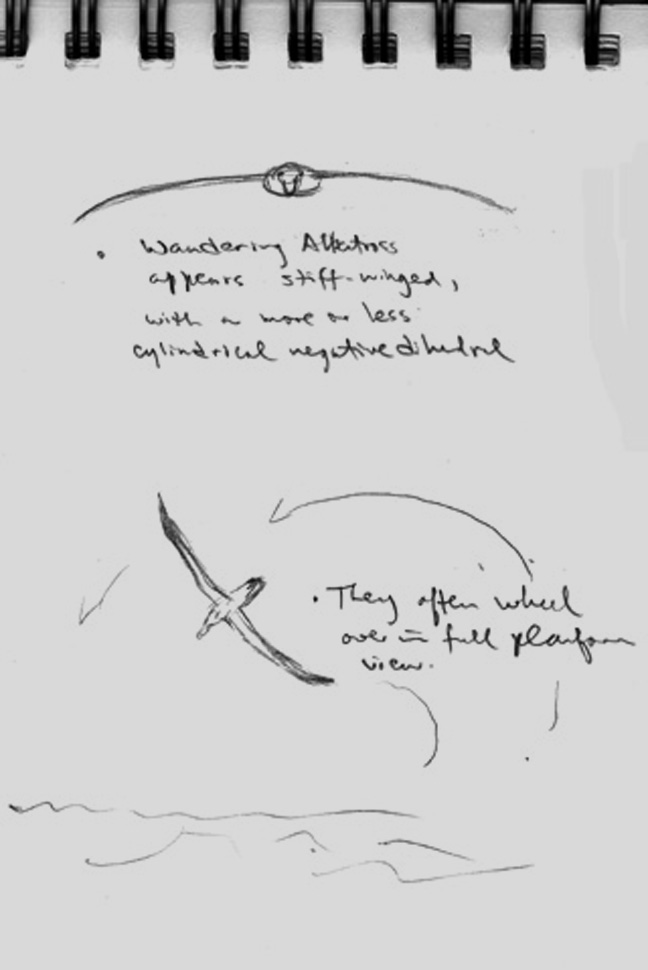
Wandering Albatross Quick Sketch

Soon the Wandering Albatross appears. We see mostly immature birds of this species, which even in the adult plumage is somewhat drab when compared with the other albatrosses. But this bird’s blessings are not cosmetic, not skin-deep. The Wanderer possesses unimaginably efficient wings. Wings capable of keeping the bird airborne day after day after day, almost never needing to be flapped. Wings sensitive to the slightest nuance of wind, of updraft, of gradients in the boundary layer. This species’ grace and beauty are functional, structural, geometric, aerodynamic. This bird is the consummate flier, with slender sail-plane like wings that can bring tears of joy to the eyes of an aerodynamicist.

Wandering Photo

Occasionally bestowing on us a close look as they glide over our heads, these huge birds with their eleven foot spans more often skim the wave tops one or two hundred meters away. They are nearly always within sight of the ship, but not tethered in its wake like their molly-mauk and petrel cousins.

Wandering ALbatross SKetches

I have dreamed of seeing the Wandering Albatross for years, since reading The Rime of the Ancient Mariner as a child. My desire only intensified when I became an engineer and read the works that document the astounding feats performed by Diomedea exsulans. In 1964 Clarence Cone of the Virginia Institute of Marine Science published a mathematical analysis of the energetics of dynamic soaring that showed albatrosses to be the original wind machines, able to extract energy from wind and wave with the clarity, precision and unerring control with which they maintain their attitude and position in time and space.

Cone Analysis SKetcvh.

In 1982 Colin Pennycuick made field observations of the gliding performance of the albatrosses of South Georgia and quantified their impressive performance. P. Jouventin and H. Weimerskirsch tracked Wandering Albatrosses using satellites in 1990 and determined that the birds made foraging flights away from their nests of from 3 to 33 days that covered from several thousand to 15,000 kilometers. Credible documentation of incredible feats.

Now I stand at the stern of the Akademik Ioffe, shifting my weight from leg to leg as the ship lifts and rolls on the swells of the Drake Passage, the wind whipping my cheeks with spume plucked from white-fringed waves. The surface of the sea is almost alive, in constant motion. I stand and watch them: Real albatrosses. Live albatrosses. Albatrosses sharing with me this position in time, this position in space, this raw and lovely intersection of nostalgia and reality.

Wandering Albatross Photo FIltered.

At the edge of the horizon a Wandering Albatross skims the waves. The swells reveal then hide, reveal then hide the bird. It suddenly wheels up above the plane of the water, dark against the leaden sky, showing me its perfect planform. The arc of its path brings it nearly vertical to the surface of the sea. There is a catching in my throat. The bird reaches across the water and captures a bit of my soul. I hold my breath. The bird hangs there in mid air. I have seen my albatross at last!”

– Roy Beckemeyer, Drake Passage, 22 January, 1998

My travel journal entries from a trip I made 15 years ago to Antarctica have long been posted on my web site http://www.windsofkansas.com. I have decided to extract some of them and post them here on my blog so that they are exposed to a different audience. The text and rough sketches are from my Antarctic Journal. The schematic diagram is from the cover of “A Mathematical Analysis of the Dynamic Soaring Flight of the Albatross with Ecological Interpretations,” by Clarence D. Cone, Jr., Virginia Institute of Marine Science Special Scientific Report No. 50, May 1964. The color images are from photos I took on the 1998 Antarctic trip and are of a Wilson’s Storm Petrel and two different Wandering Albatrosses. I used Photoshop filters to make the photos look like paintings.