phanaerozoic

Musings about life on Earth in all its aspects…

Another Place in this World a Woman Can Walk

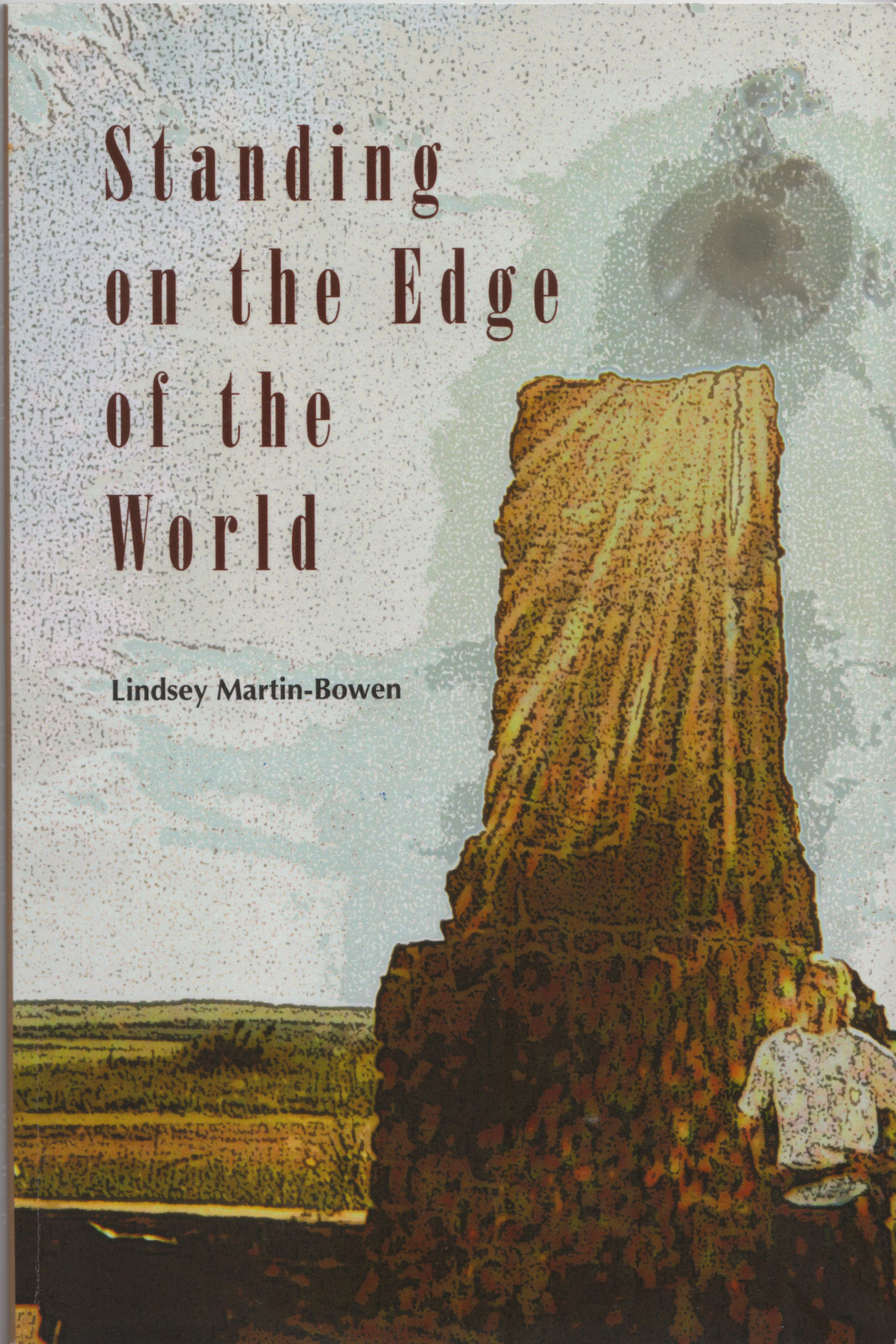
Standing on the Edge of the World Cover

Review of the poetry book:

Standing on the Edge of the World by Lindsey Martin- Bowen, 2008, Woodley Memorial Press, Topeka, KS, ISBN 978-0-939391-44-8, 92 pp., $10.00

“The night is Dresden…” reads the opening line of Lindsey Martin-Bowen’s poem, Working Toward the Last Line, as she compares the arcing flashes, sparks, and chaos of downed tree limbs and power lines in a raging Kansas ice storm to a WWII firestorm. She uses such apt but unexpected allusions throughout this book, enriching her poems and expanding our perception of her poetic vision. This is work of sumptuous insight and surprising conjunctions. In one of my favorite poems in this book, Hanging Out in the Student Center, Martin-Bowen juxtaposes Lorca, Caravaggio, Borges, and Ferlinghetti, who comprise a strange enough crowd in themselves, then places them against the streets and landmarks of Kansas City Missouri: Troost Avenue, Swinney Gym, Country Club Plaza. And, by God, they all seem to belong there; you find yourself wanting her to text you so you can follow her down those streets the next time she gets them all together.

Martin-Bowen is as effective in making magic of our prosaic small town back yards (“…an old tire swing moans empty,” from Dancing with Aunt Virginia) as she is in showing us the wonders of the world. Here is how she sees classic Italian statues: “…I think about / how Michelangelo freed their forms, / how their eyes have no pupils. / They stare into the future / without flinching / and show no regret.” (from the poem Statues).

The book is divided into four sections: Seasonscapes, Another Place in this World a Woman Can Walk, Two Brown Bears Dancing, and Beyond the Vanishing Point. There are rich gifts to be found in each section, but I wish to focus next on some of the poems that appear in the last.

I am particularly attracted to the way in which Martin-Bowen can bring Biblical characters to life with layered depth and fierce vitality. Peter’s Wife asks: “How could you abandon me for a man? / … you won’t live in Capernaum again. / You won’t fish again. You won’t drink again. / We’ll no more share our strange sin, / this earthy love.”

And listen as myrrh-bearer Mary Magdalen Rebukes Peter: “… / At our gatherings, / you boast of your loyalty / and call me a whore / who will destroy him. / But he knows your game: / when I wail at his grave, you will / deny you walked with him, / deny you slept with him, / deny you knew his name.”

In The Madonna she captures the essence of all the lovely Marian icons we have ever seen “… / I shiver above flames / in tiny red and blue jars / … / My son stepped through fire. / It darted from the eyes of throngs / that had fanned him with palms / the week before… / …I give off no sweet scent. / It’s the candles’ perfume that fills the nostrils / of seekers who fall prostrate. / Far from my fingers, they bend / too low to touch.”

Pick up a copy of Lindsey Martin-Bowen’s book. Read it. Here are words that will remind you what an exquisite combination we humans are of the spiritual, the passionate, the proud, and the profane. Hers is the work of a perceptive and extraordinary poet.

– Roy Beckemeyer, 24 June, 2015

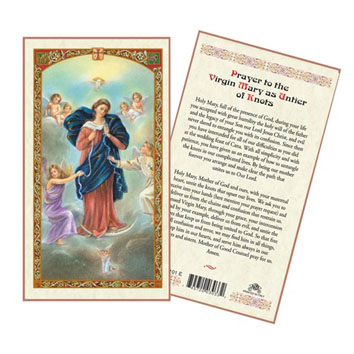
Prayer Card Poems – To the Virgin Mary as Un-tier of Knots

Untier of Knots copy

Dearest Mary,

I have really done it this time,
knotted myself up in rhyme.
I tried to return from the road of sin,
then went and hogtied myself again.

Half-hitched my legs together once more.
Yes, I know, the last time I swore
I would carry my knife, cut the knots through,
but sorrow and strife has me back here with you.

Square knot and granny,
there are so darned many
knots that I thought I knew
how to untie, but here I lie
can’t untie them and so I chew
and twist, and break fingernails.
Everything I try, it seems, fails.

Oh Mary, I dearly need your aid.
So please untie these knots so I
can become one of the saved.

– Roy Beckemeyer

I know that Catholics have a lot of things for which they ask the Mother of God to intercede with her Son for them, but this was a new one for me. So I could knot resist trying my hand at this poem/prayer. Back during my stint in the Boy Scouts I could have used help from the Saint of Tying Knots, but didn’t then and don’t now know who that is. Back to google, I guess.

Prayer Card Poems – In Loving Memory

In Loving Memory

In Loving Memory

Size seems about right. It’ll fit in anyone’s shirt pocket so they will be able to carry it around, run it through the laundry by accident, and then finally forget me, wash off any residual grief. Symbol has me stumped. Jayhawk, WuShock, Flying Billikin, maybe an airplane or a dragonfly or a corkscrew. Yeah, let’s go with the dragonly. It looks sort of like a cross and will be both natural, fitting, and as close to religious as I got. Should the photo be studious or serious or happy? I don’t know, but I think I would like a shit-eating grin (forgive me, Father) so everyone who looks at it wonders what I was up to. I would like to write the poem, and since I don’t know when I will be needing the card, let me do the custom text now:

Small town boy met small town girl raised
small town kids hiked and travelled and
moved to the city and built airplanes and
made wine and square danced and acted
pretty much like an adult most of the time
and then like a kid for the rest of the time
and was in love for nearly the whole time
and right up to the end for sure and went
to church as a kid and young man and hopes
and prays that won’t keep him out of heaven
since he did try to be and do good but that
doesn’t work according to some theologists
and so pray for him if you think it might do
some good, ya’ll, if you want to and have
the time, otherwise don’t worry. Amen.

And please look through those 1500 images in 20 different categories and find a nice picture of the sky. I always liked sky pictures, and there was sky everywhere I ever went.


– Roy Beckemeyer

Theotokos


“Her eyes are darker than the deep cathedrals,
her words come dressed as mourners.”
– T
homas Merton, from the poem
“In Memory 
of the Spanish Poet Frederico García Lorca”

Her eyes are darker than the deep cathedrals

Words dressed as mourners
are poised on her lips. She pouts
a bit, a quiver wavering. She
contemplates hiding her face
in the gold leaf of His halo.
But she cannot take her eyes off us.
She stares. “It is you, and you,
and you, too – all of you who
will use this Child.”

She cannot take her eyes off us.
She avoids looking to the side.
The lance, the nails, held
in the hands of those angels,
are nothing compared with
the pierce of her gaze.

Her eyes may hold tears
somewhere in their depths,
tears welling up, a reservoir
of tears shimmering blackly,
but she does not share them
with us. She just watches and
stares, drawing out our souls,
pulling us into the nave,
the transept, the arched
and domed depths of her face,
into her eyes, dark as cathedrals.

– Roy Beckemeyer

When I first read those powerful lines in Thomas Merton’s poem, “In Memory of the Spanish Poet Frederico García Lorca,” they called to my mind a religious print, “Our Mother of Perpetual Help,” that had hung on the wall of our home when I was a child. Merton’s poem did not, of course, make reference to Mary, mother of Christ, but the images seemed too special and appropriate to her to let them go. In addition to using the lines as a quote to introduce my poem, I borrowed them, the 2nd directly for the 1st line of my poem, and the 1st paraphrased in the last line. I hope that Merton would not have been offended by this.

Images of the Virgin Mary, called Theotokos (“Bearer of God”) icons – are of special importance in the Orthodox and Roman Catholic churches. This famous icon, titled Our Lady of Perpetual Help, was painted by an unknown 15th Century Post-Byzantine artist of the Cretan school. The original wooden icon measures 17″ × 21″ inches and is painted on hard nut wood with a gold leaf background. The image depicts the Virgin Mary wearing a dress of dark red, representing the Passion of Jesus, with a blue mantle, representing her perpetual virginity, and cloaked veil, which represents her pure modesty. On the left side is the Archangel Michael, carrying the lance and sponge of the crucifixion of Jesus. On the right is the Archangel Gabriel carrying a 3-bar cross used by Popes at the time and nails. This type of icon is also called a Hodegetria (literally: “She who shows the Way”) composition, where Mary is holding the Child Jesus at her side while pointing to Him as the source of salvation for mankind.

Thomas Merton (1915-1968) was a Trappist monk and one of Catholicism’s most prolific and respected modern apologist authors. Merton wrote more than 70 books, mostly on spirituality, social justice and pacifism; he also wrote many essays, poems and reviews. His best-selling autobiography, The Seven Storey Mountain (1948), was featured in National Review’s list of the 100 best non-fiction books of the 20th century.

Merton

Spanish Moss and Mooonlight

Spanish MossR2

The shape on paper was hers,
light pencil tracings
of the first ideas
of how the moss would hang
in front of the moon,
the humid haze would hover
in the luxuriant Louisiana sky.

Now he was shaping it
in three dimensions,
his fingers and hands
working together, centering,
centering, pressing, smoothing
the Lake Pontchartrain clay;
his strong left leg powering
the treadle, the wheel spinning,
the vase rising into an almost
living, an almost organic form
from a shapeless lump of earth.

“Pinch in the neck,” she said,
“there above that rounded shoulder
that suggests the tops
of the trees – constrict the clay
into a sharply defined ring,
a cylindrical edge that will
pronounce: Here is a vase –
a form with a hollowness,
with emptiness, inside it.”

“Oh,” she said, “the blue and pale
lighted circle of trees
I have in mind will hold
within that hollow space
where all vases hide
their secrets, the mystery
of moonlit nights and bayous.”

She carries off the greenware,
places it on her turntable
and begins to shave off
strips of clay, layers of clay,
snippets of clay that drop
to the workbench, leaving strands
of moss to fall from the trees.

As clay curls off the edge
of her embossing knife,
the live oaks and bald cypress
rise, their branches woven,
and everywhere the Spanish moss,
drapes, droops, caresses
the tree forms, bounds
the growing image from above
the way bayou trees frame
the southern night skies.
With the first firing, the vase turns
white as the fullest moon,
ready for the glaze. The blues,
pale, paler, palest,
separate sky and foliage,
shape and void,
turn black bayou waters
into a moonlit blue sheen,
mark the sky for radiance
with flowing silken glaze.
The trees across the water loom
upward, reaching, reaching,
and the round moon hides
behind fingers of moss,
the deepest blue moss,
moss that loves live oaks
and warm nights and calling owls
and chirping tree frogs.

And then the final fire, the kiln blazing,
clay and glazes merging, capturing
in the chemistry of ceramics and heat
a moment of time, making it
a piece of forever, burning
into reality an imagining
of shape and form and color
and shadings. Oh, yes, here is what
she saw before she began to sketch.
And here is what his fingers felt
before he took up the clay. Here
is what they made, together,
from earth and fire and memories,
from Spanish moss, from live oaks,
from moonlight.

– Roy Beckemeyer


This is an ekphrastic poem inspired by a Newcomb Pottery vase thrown by Joseph Meyer and deeply carved by artist Sadie Irvine with live oak trees and Spanish Moss in front of a full moon. The vase, pictured above, was made in 1919.

Sample Poems from “Music I Once Could Dance To”

My debut poetry book, “Music I Once Could Dance To” (ISBN-13 978-0-9795844-8-0, 6″ x 9″, 100 pp., $10), has been well received and we are on our second printing. It is published by Coal City Review and Press of Lawrence, Kansas. It contains an introduction by past Kansas Poet Laureate Caryn Mirriam-Goldberg.

I have made  a sample of three poems from the book available as a pdf file downloadable for free: (Click on the image of the musical notes).

Here is a link to a recent review (“Wichita poet’s debut collection is rich and resonant“) that contains excerpts of portions of other poems so you can get a better feel for the diversity of poems in the book.
If you find them of interest I would be so happy to have you buy a copy. The book is a steal at the price, is beautifully designed and printed in addition to containing poems that I hope may set you to singing or dancing. Check out the publisher’s web page HERE.

You can read more about the book’s origins and the process of getting it into print, photos from some recent readings, and other links at my Author’s Page.
Thanks!

Music I Once could Dance To- Front Cover

– Roy Beckemeyer

Music I Once Could Dance To: poems.
Roy J. Beckemeyer. 2014.
Introduction by Caryn Mirriam-Goldberg

ISBN-13 978-0-9795844-8-0
6″ x 9″, 100 pp., $10.

Available from Coal City Review and Press,
Brian Daldorph, Editor/Publisher
Lawrence, Kansas

What is Here That Has Been Here from the Beginning

Revi71+jBV7ZPbLew of the poetry book:

Autochthonous: Found in Place” by Dan Pohl with Illustrations by Jessie Pohl, 2014, ISBN 978-0985458669, Woodley Press, Topeka, Kansas

Dan Pohl’s “Autochthonous: Found in Place,” is a paean to his home state, Kansas, its inhabitants, his circle of family and friends.  True to its title, the book focuses on the sense of Place that characterizes poetry from the heartland at its best. Phrases like “explorers came when the stars looked younger,” and “…field / Stones, picked out to plow a good life,” bring us into the fold of those who made this prairie what we see today, gave it its names, showed us all the ways they had prepared it for us.  He offers advice and aid to those travelers who hurry through the wind-blown plains, never willing to take the time to see what one has to look a bit harder to find. In these pages he takes them by the hand, provides “the answer, hard enough to stamp lines / Onto the outside corners of their eyes.”  Oh, and what telling answers he gives, patient, generous, insightful in the wisdom he gleans from the everyday, the phenomenal, the rare, the commonplace.

With images of prairie dogs burrowing “deep into their Kansas seas…Centuries deep,” and haylofts as “the ship keel of / Trusses,” he invites us to see with new eyes what we thought we knew. He is not afraid to build with his words on the page not only a metaphorical image, but a graphic picture. In “The Rule,” a simple story/fable of “Children…Quickly learn to step / To the side  To climb the slope…for a softer / Smoother glide  For the common / Good,” we can hold the page an arm’s length away and see two columns of staggered word steps bounding either side of the clean sledding path  that runs down the center of the page. A brilliant example of “concrete” poetry at its most subtle and compelling.

The poetry here appeals to all the senses. “Saying Grace” enshrines home cooking and sends you to pulling pots out of the pantry looking for the deep fryer. After reading “Poet Elliott’s Advice…” we rush outside and put our ear to the corner light pole to share “its cark cello hum…a low-frequency Hindu ‘Om’.” In “Hidden Membership” we are made party to the secret life of a church’s folding chairs, and we feel their discomfort beneath our rumps as the meeting drones on.

It is with moments taken from familiar events of everyday life that Dan reveals his love for life and for his family. In “Feeding After Four,” he tires of shopping before his wife does, stops to watch fish in an aquarium, catches a pair of turtles feeding: “…his companion, who / Softly, tenderly, slides behind him / And slips her long slender neck / Under his left side near his heart. / She wedges under his jaw and pressures / Against his red-striped nose to snatch / His bit of bread as lovers often do.” He takes us, with those simple last four words, from the mundane to the sublime so quickly, so unexpectedly.

And occasionally Dan Pohl will take you further afield, to more exotic places, as well. Close your eyes and you are on a river steamer on the Niger: “The patient river rusted away / The name, each day the captain / Double drunk by noon” (from the poem “Fangs and Water at Kanthuri, 1890”). In “Lover’s Moment,” he writes: “I ride the bus to San Mida / The journey ends before me / I will run what I can / Though the wind will need to help / Raise your wish on Salida’s Hill.”

Below those words is a delicate pen and ink sketch of a kite dancing in the air. Scattered through the book are drawings by Dan’s daughter, Jessie. They embody her interpretation of her father’s words, show how those words float in her mind the way this kite floats in the sky. This book of poems is more than most: it contains a father’s words embellished and burnished to a brighter hue by his daughters sketches.

All in all, you could not do much better than to pick up a copy of this book, take it outside into the morning along with a steaming cup of coffee, and find yourself.

– Roy Beckemeyer

The Monastery’s Seven Hours

Matins, midnight’s bout of prayer,File:BritLibRoyal14CVIIFol006rMattParisSelfPort.jpg
by yawning monks kneeling there,
eyes half closed, or all the way,
hoping for the break of day.

Lauds‘ laudatory monks, alert,
warmed by the sun, all assert
their blessings, state them to and fro,
no need for rooster’s morning crow.

At Terce, thrice now the prayers have rung,
the blessings chanted, the psalms sung.
The monks, all now fully awake,
bellow their prayers for all our sakes.

Sext is when the monks all ask
blessings on these gifts, the tasks
of kitchen cooks. These monks, cowled,
just men like us whose stomachs growl.

None the hour after the lunch,
when eyes again, I have a hunch,
get heavy-lidded and partly close
against the sun’s bright pm glow.

At Vespers the candles are brightly lit
and day’s end comes to the pews to sit.
Monks ponder charity and bits of grace,
till contentment falls on each one’s face.

Compline marks the end of day,
“Now I lay me down,” they say
These monks, serene, now each has found
peace as the liturgical hours go ’round.

– Roy Beckemeyer, April, 2014

This poem was an exercise for a poetry workshop I am leading called “Poetry by Sevens,” in which we write poems inspired by some subjects typically grouped in sevens.  For example, the Seven Wonders of the Ancient World, the Seven Dwarves, the Seven Deadly Sins, etc.  This one used the Seven Hours of Liturgical Prayer.  I tried to think of monks as just men, not some sublime praying creatures.

The illustration is from Wikimedia Commons and is a self portrait of a 13th Century  Benedictine monk, Matthaeus Parisiensis.


Poetry Month American Cinquains

Poetry Month American Cinquains (A five-line poetic form in which lines 1 through 4 have 2, 4, 6, and 8 syllables, respectively, and line 5 has 2 syllables).

April 1 (inspired by a drive through the Flint Hills after prairie spring burns):

The green
already there,
woven among black ash
remnants, fiery tweed of renewed
prairie.

April 2 (inspired by a Kim Stafford reading at Watermark Books, a William Stafford Centennial event):

Passion
for poetry.
Might it be genetics?
Talent passed from father to son?
Perhaps.

April 3 (inspired by this also being Jazz Appreciation Month):

Triplets,
swing notes, two-four,
Dorian, Phrygian,
sevenths, ninths, elevenths, thirteenths.
It’s Jazz.

April 4 (inspired by the first thunderstorm of the spring):

Rumble
Out at the edge
Of hearing. The clearing
Of a storm’s throat, a stage whisper:
“Action!”

April 5:

Cursive.
Writing paper.
Pen. Letters. Elegance.
Illuminated manuscripts.
By Hand.

April 6:

A list
poem is always
fun but then there must be
some scheme or logic, rationale,
something…

April 7:
Cattails.
Corruscations.
Contretemps. Cavalcades.
Conditioning. Crepuscular.
C-words.

 April 8:

I’m a
container for
all that blood, corpuscles –
white and red – and plasma. The stuff
of life.

April 9:

old dogs
lying beneath
our feet breathing softly
what more could we need in old age
than this

April 10:

blossoms
perch in clusters
on pear trees like close friends
bees flit, flirt, hum as petals start
to fall

April 11:

Tax day
is a comin’
another check I’ll write
not enough deductions for a
refund

April 12:

Where the
heck are April’s
showers? Here comes young May,
looking to plant flowers. Too dry?
Bummer!

April 13:

A – P –
R – I – L – T –
H – I – R – T – E – E –
N – T – H – April Thirteenth –
Spelled!

April 14:

Tulips
catch snow, don’t scowl,
stand sturdy and strong, tall,
but think of Amsterdam in spring,
and yearn.

April 15:

promise
of blood red moon
old earth’s shadow once more
makes the moon’s visage dimly blush,
chagrined

April 16:

Texting
with an iPhone
takes patience, eyesight, small
fingers, I have learned – then again,
have I?

April 17:

On this
day in the past
Thornton Wilder was born.
Gairrison Keillor told us this
today.

April 18:

Friday.
On Calvary
Crucifixion and death.
God’s Friday, Pious Friday, Good
Friday.

April 19:

Doctors
have specialties
like gynecology,
cardiology. I prefer
GP’s.

April 20:

Easter
Mornings the sun
rises, brimming over
with forgiveness, atonement for
our sins.

April 21:

Flower.
Bloom intensely.
Color with abandon
Every day of every spring.
Flower!


A Dalliance between Science and Literature – Naming Animals

I currently edit a scientific journal. Writing and editing science are of course different from writing and editing literary works. Perhaps the most immediately noticeable difference is the typically dry, unemotional language and style of scientific papers. Science writing has become a bit more relaxed and less stilted and proper in recent times, but is still saddled with having to be accurate and precise and usually is less than inspiring to the lover of words and language.

There is one area of scientific writing where the scientist with poetry in his soul might get by with being lyrical – the description of a new species of animal. The way we name species was established by the great 18th century Swedish botanist and zoologist Carl Linnaeus. The tenth edition (1758) of his classic book, Sytema Naturae included scientific names for more than 12,000 species of plants and animals. He devised what is called “binomial nomenclature” in which each animal is given a name comprised of two parts, and he set up a classification system based on a nested hierarchy of animals that depicts how they appear to be related.

Each animal’s unique two-part name, the binomen, consists of a genus name and a species name. A genus may have more than one species associated with it. For example, Canis lupus, the gray wolf, and Canis latrans, the coyote, are both in genus Canis. Canis is Latin for “dog”. Lupus is Latin for “wolf”, while latrans is Latin for “barking.” Thus Canis lupus literally means “wolf dog” and Canis latrans “barking dog.”

The binomen is always treated as a Latin phrase, and is italicized. (Even if the origin of the name is a Greek word, or even an imaginary word, it is treated as a Latin word when used in a binomen.) The genus name is capitalized, the species name is not. The species name may be an adjective (modifying the genus name in some way), in which case it must agree in gender with the genus name according to rules of Latin grammar (the species name may also be a noun, in which case it need not agree in gender). There are all sorts of rules established for assigning names correctly, and for determining precedence in the event that two scientists happen to apply the same name to different animals. The rules are set down in the International Code of Zoological Nomenclature. By now MFA English majors are sighing in boredom, linguists are going “mmmmmm,” and zoologists are saying “I already knew all that.”

The point of this is that there are rules for the naming of species but there is a lot of latitude in selecting the names themselves. Some zoologists seem to use almost no creativity in assigning names, others can be quite inventive. In most papers in which species are newly described, there is required to be a section titled “Etymology,” in which the scientist’s derivation of the binomen is explained. That is precisely where examples of discrete or disgraceful dalliances between science and literature may be observed. Let me give some examples.

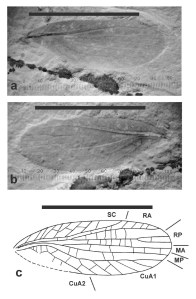
It is in poor taste to name an animal after yourself, but naming one after another person is a way of giving that person a sort of enduring recognition – the name will be around as long as people are studying and naming animals. Here is a picture of the front wing of an insect that lived about 275 million years ago in what is today Oklahoma (I study and name fossil insects, which most often are preserved as wings).
RaaschiaFig1abcz

(From: Roy J. Beckemeyer, 2004, “Raaschiidae (Grylloblattida: Protoperlina), a new insect family from the Lower Permian Wellington Formation of Noble County, Oklahoma,” Journal of the Kansas Entomological Society, 77(3): 215-221.)

The specimen was collected in fossil beds that were discovered in the 1940’s by geologist and paleontologist Gilbert O. Raasch (1909-1999). The insect was sufficiently different from known related insects that I assigned it to a new genus, and named the genus after Raasch. To “Latinize” the name, I called the insect Raaschia. It still needed a specific name, and I chose the rather mundane practice of using the location where the specimen was found. When doing this, the place name is given the ending “-ensis,” meaning “from.” The name for the insect became: Raaschia oklahomensis. Not that inventive or poetic, but it is an honorific that recognizes Gil Raasch and permanently links him to the state of Oklahoma. And I did like the slight alliteration of the “s” sound in the two names.

Another interesting example may be found in a paper on fossil insects from Alabama that I coauthored with Michael Engel of Kansas University.

Anniedarwinia

(Roy J Beckemeyer and Michael S Engel, 2011, “Upper Carboniferous insects from the Pottsville Formation of northern Alabama (Insecta: Ephemeropterida, Palaeodictyopterida, Odonatoptera)” Scientific Paper, University of Kansas Natural History Museum 44: 1-19)

I worked on this group of insect fossils not long after I had read Randal Keynes’ book, “Annie’s Box: Charles Darwin, His Daughter And Human Evolution” (Fourth Estate, London, 2001). He chronicles the interactions of Darwin’s family life and scientific work during the time he was formulating and documenting “The Origin of Species.” So the first insect described in this paper was named to recognize this all too often neglected aspect of Darwin’s life. The name we assigned was Anniedarwinia alabamensis. Here is our statement on the etymololgy of the genus name:

“The new genus-group name honors Charles Darwin’s humanity by remembering his second child … Anne Elizabeth “Annie” Darwin (1841-1851). Darwin nursed his ten-year-old daughter through the final stages of her illness. Her death broke her father’s heart: ‘We have lost the joy of our household, and the solace of our old age: she must have known how we loved her; oh that she could now how deeply, how tenderly we do still…’ (Charles Darwin, 30 April, 1851: Keynes, 2001).”

Once again, I chose to use the state in which the fossil was found for the species name, and the result, Anniedarwinia alabamensis, again has a certain euphony that I particularly like; that, in addition to the emotional satisfaction of naming a species for Darwin’s child, make this one of my favorite scientific names.

I will stop with these two examples; I suspect you get the idea. It is so pleasant, when reading through the monotonously detailed descriptions that are required to validate and definitize a new species, to come across the etymology paragraph – and bask in a brief diversion into the human and artistic, a glowing moment of dalliance between science and literature.