phanaerozoic

Musings about life on Earth in all its aspects…

A Renga Project for a Group of 6 to 12 Poets

I have been moderating a poetry session three times a year for LifeVentures, a program for seniors in Wichita, Kansas. Each of the three “semesters” is eight weeks long. The poetry sessions are an hour long, so each semester we have eight hours total together, plus the time each participant puts in at home. A typical class runs around eight to ten people. I am always looking for new themes for us to explore.

Last spring I was one of the contributors to Kansas Poet Laureate Caryn Mirriam-Goldberg’s Kansas Renga project (see the 150 Kansas Poems blog site), so I thought it might be fun to do some rengas in our sessions. Since we had only eight meetings, I decided we would do seven-stanza rengas, with each participant writing stanzas one and seven of their renga, and contributing a stanza to each of five other rengas in the intermediate weeks.

Since I never know exactly how many folks will sign up, I worked out sequences for class sizes of anywhere from six to 12 poets. That way we would end up with a renga for each poet to which five other class particpants had contributed. One neat thing about this project is that even the people who would ordinarily beg off and not write anything for one or more of the classes, felt a real obligation to write every week rather than let any of the other participants down.

Here is a link to a set of matrices (as a pdf file) that you can use for doing this project:

Renga Sequence

There is a column for each participant. If there are 10 people in class, write the numbers one through 10 on slips of paper and let everyone draw from a hat. Suppose you drew number seven. The seventh column in the matrix for 10 poets lists your renga sequence. You would write the first stanza. The next week, you handed your stanzaa to poet number nine who would write the second stanza, and so on. The poem would be passed to poets eight, four, three, and 10 in that order, leaving you to write the final stanza.

I had made a list of “subjects” from which each participant could choose a theme for his/her renga (e.g., “Zero Hour”,”Music Lessons,” “Our Town,” “Symphony of the Universe,” etc.). This helped to provide focus for the contributors, although each was to find something in the stanza immediately preceeding theirs as their main source of inspiration.

It proved to be an exercise that everyone enjoyed, everyone contributed to, and that provided us all with some interesting and memorable poem sequences. Participants found it particularly gratifying to see how others responded to their work.

– Roy Beckemeyer

DAILY I FALL IN LOVE WITH POETS

On January 18, 2011, Garrison Keillor’s Writers Almanac public radio spot featured a humorous poem by Jason Fried entitled “Daily I Fall in Love with Waitresses.”  Several weeks later, poet Susan Thurston, who couldn’t resist the temptation, answered with her poem, “Daily I Fall in Love with Mechanics” (Feb. 8, 2011). The two poems can be found on the Writers Almanac web site at:

<http://writersalmanac.publicradio.org/index.php?date=2011/01/18>

and

<http://writersalmanac.publicradio.org/index.php?date=2011/02/08>

respectively.

 Of course, the gauntlet had been thrown with Fried’s poem, but Thurston’s response led to downright poetic anarchy.  The group of local writers, the Wayward Poets, that I belong to and meet with weekly at Mead’s Corner: A Fair Trades Coffee House here in Wichita, Kansas, couldn’t resist joining in the fray.  Soon love was declared for cowboys, mailmen, baristas, meter maids, and so on – you get the picture.  I shared one of my poems, “Daily I Fall in Love with Poets,” at a read-around at the Kansas Authors Club 2012 convention in Salina, Kansas last weekend, and was encouraged to post it.  So here it is, a bit of tongue-in-cheek poetry for the day:

 DAILY I FALL IN LOVE WITH POETS

 Daily I fall in love with poets,

with their ink-smudged notebooks, their names

stamped in gold leaf on the linen covers:

EDNA  EMILY  ELIZABETH  SARA  CHRISTINA,

female poets with pens in their hands.

I love how they make me trace their women’s words

through lines that flow

like the curves of their clinging smocks,

their conforming skirts, their cloaked shawls.

I love the ones as slender as their

first slim volume of poems,

and I love the ones with the fullness of form

of their collected works.

I love the femininity of their free verse

and the sensuousness of their sonnets,

their proper but passionate parsing,

their wanton ways with words.

In reading their printed poems

I can imagine their graceful hands gliding,

feel them inscribing their verse and rhymes

on my parchment skin in India ink.

Daily I fall in love with poets pictured

posing on the covers of chapbooks,

prim or purposeful, pouting or pert.

They know the secrets of prosody

and I want them.

 They have husbands and children and lovers

or all,

but are always pictured alone,

like Edna posing beneath that Magnolia tree

her first year at Vassar.

Daily I fall in love with poets;

I pull out one of their books:

one standing upright on the shelf,

or one leaning, provocatively, 

against its neighbors,

but in the end I am invariably left hungry

for another poem, and always, always,

I arrive at the colophon

all too soon.               

– Roy Beckemeyer

(Inpired by Elliot Fried’s “Daily I Fall In Love With Waitresses,” and Susan Thurston’s “Daily I fall In Love With Mechanics,” and dedicated to Edna St. Vincent Millay, Emily Dickinson, Elizabeth Barrett Browning, Sara Teasdale, and Christina Rossetti)

“Step down, Pilgrim. Take a look.” – John Wayne

I have been thinking for some time now of writing down some thoughts on books that have moved me, stayed with me for most of my life, or influenced the direction my life has taken.

A recent announcement I received from Eighth Day Books (a very special store located in Wichita, Kansas) about a book titled “Annie Dillard and the Word Made Flesh: An Incarnational Theory of Language,” by Colleen Warren (Lehigh University Press, 2010), in which the author focuses on an interpretation of author Dillard’s work in light of Christian theology, brought to mind my experiences with Annie Dillard’s many publications.

It also reminded me that it had been a number of years since I had read “Pilgrim at Tinker Creek,” Annie Dillard’s magnificent Pulitzer Prize-winning book (Harper Magazine Press, 1974). “Pilgrim” is a book that literally changed my life. The book dealt with Dillard’s experience of nature, her explorations of the natural world around her home, and her attempt to put what she saw in the context of her theological beliefs. Its focus was with really seeing, and then really thinking about nature. (Thus the John Wayne quote used to title this essay.)

I first read “Pilgrim” in 1975-1976, and it significantly altered the focus of my non-professional interests. I had finished up my Ph. D. in aeronautical engineering in 1974, and was enjoying doing airplane noise-reduction research work for Boeing. But I missed academic work, and wanted to take some other course work that would broaden my knowledge base beyond mathematics and engineering (although in getting my B.S. in aeronautical engineering from St. Louis University in 1962, I had taken a number of courses in philosophy and religion, as the school was administered by Jesuits).

My wife and kids and I were also just getting into backpacking, and were using our yearly vacation trips to travel the mountains of the western U.S. We were encountering all sorts of plants and animals and geological features that were new to us, and so I had begun reading nature field guides and nature books. Dillard’s “Pilgrim,” and “Land Above the Trees: A Guide to American Alpine Tundra,” by Ann H. Zwinger and Beatrice E. Willard (Harper and Row, 1972) were the first two nature books that really got my attention. Based on those books, I began taking a variety of field ecology classes that became the foundation for a second post-retirement “career” in biology and paleontology.

I thought that it would be interesting to go back and read these books in light of my many subsequent years of working in natural history and biological science. I am wondering how my opinion of the books might be changed. So I will be re-reading “Pilgrim at Tinker Creek,” as well as reading Warren’s new book on Dillard, and reporting on them in this blog in the future.

To help bring back the impact of my first reading, I am going to quote from a book review of “Pilgrim at Tinker Creek” that I wrote for the newsletter of a local outdoor equipment store (Mountain High, located in Wichita, Kansas) back in 1976:

“Although I have been a voracious reader and a bibliophile from the age of twelve, I can recall actually wearing out only three books. One was a handbook I referred to almost daily in my work over a period of some fifteen years. Another was a textbook I used in a particularly traumatic bout with a three-smester college mathematics course. The third was Annie Dillard’s ‘Pilgrim at Tinker Creek.” I just went out and bought a second copy after constant thumbing and exuberant page turning reduced the first to tatters within a year. Without a question, this woman can write! She is a poet-naturalist-philosopher whose perceptions of the natural world will excite you, bewilder you, enchant you, cause you to lose all sense of proportion and restraint. You don’t have to read far in this intensely personal book before you find yourself wishing you could converse with her directly. I find myself continually turning to her picture on the jacket, and saying things like ‘Of course, I know exactly what you mean…’ or ‘Yes, but what about this…’ or, sometimes, just staring, open-mouthed, caught breathless by a particularly exquisite passage.

‘Pilgrim at Tinker Creek’ is a Pulitzer Prize-winning book which chronicles Annie Dillard’s attempts to come to terms with nature. She is a year-round walker, stalking the banks of Tinker Creek, which flows near her home in the Blue Ridge, and taking in everything around her. Too often, natural history seems to be reduced to classification and categorization, to the branding of each living thing with two Latin names and a set of statistics in metric units.

Miss Dillard, however, has something more important to convey to us than an enumeration by genus and species, than a catalog of behavioral patterns and eccentricities. She roams metaphysics and science, exploring and probing, seeking out the essence, the gut-facts of nature. Her thoughts and visions are recorded on what are surely some of the most striking and memorable pages ever to appear in print; the beauty of her prose belies the fact that these are simply words printed with black ink on white paper. This is a High Mass, a celebration of the raw wonder and mystery that is life. This is a remarkable book, written by a truly remarkable person.”

I was obviously impressed by this book and by Annie Dillard’s writing (I subsequently bought copies of every new book she wrote). Now to see how a pilgrimage of 36 intervening years might have altered my perceptions…

– Roy Beckemeyer

Mussorgsky, Repin, and Ekphrasis

My wife, Pat, and I visited Russia several years ago, taking one of the Volga Waterway riverboat trips from St. Petersburg to Moscow.  We saw so many noteworthy and impressive things in Russia that it is very difficult to focus on any one particular experience, but I thought that I would try to do that today. 

I have always loved composer Modest Mussorgsky’s “Pictures at an Exhibition.”  This piano suite in ten movements was actually a form of ekphrasis inspired by an exhibition of art by a friend of Mussorgsky’s, Viktor Hartmann, an artist who died a tragic death at the early age of 39.  Shaken by Hartmann’s death, Mussorgsky and other Russian artists and intellectuals organized an exhibition of Hartmann’s works at the Academy of Fine Arts in Saint Petersburg.  Mussorgsky was inspired by that exhibition to compose his piano suite, which presents an imaginary tour of the collection.  This well-loved piece of music is thus a fascinating example of an ekphrastic work – one piece of art that celebrates another – in this case, music commenting on visual art.  (The term ekphrasis usually refers to written words, poetry, for example, that describe the writer’s response to a painting or sculpture.)

On our next-to-last day in Moscow, we visited The State Tretyakov Gallery, and saw there many, many great works of Russian art.  Among them was painter Ilya Efimovich Repin’s portrait of Mussorgsky.  The painting was done by Repin from four sittings completed ten days before the composer’s death (Mussorgsky was born in 1839 and died in 1881, and thus lived just a couple of years longer than Hartmann had). I found that the portrait struck a chord in me.  This was no romanticization of Mussorgsky, but a memorial of the real man, in his last days.  And the tragedy of his short life reflecting that of the man whose work inspired his masterwork deepened my feelings about the painting. 

In an attempt to close this circle, I decided to write an ekphrastic poem about Repin’s portrait of Mussorgsky, in the form of the composer talking to the artist:

The Amazing Ancient Murrelet

There is something very special about the birds that live most of their lives at sea – the penguins, albatrosses, petrels.  But near the top of my list of favorite birds are the alcids or auks.  These birds of the northern seas are the ecological equivalent of the southern hemisphere penguins, and are fat birds capable of diving and swimming after prey in cold water.  Alcids have the added advantage that they can fly as well as swim.   Included in the group are auks, murres, puffins, auklets, and murrelets.  And my favorite alcid is the little Ancient Murrelet (Scientific name Synthliboramphus antiques). 

The bird got its sobriquet “Ancient” from the specific name, “antiques.”  The specific epithet appears to have its origin in the Russian folk name for the bird, “Starik” (which means “old man”), which is based on its appearance.  One of the first western authors to describe these birds was Thomas Pennant, in 1784, who wrote “white, long, loose and very narrow feathers…which give it an aged look.” (These feathers occur on the side and back of the head of the adults.)

Ancient Murrelets are distributed along the Asian and American coasts of the North Pacific, from Japan, Korea and the Kurils north to Kamchatka, across the Aleutian island chain to Alaska, south along the coast to Washington State.   Some of the largest breeding colonies for these birds are on the Queen Charlotte Islands off the coast of British Columbia. 

Adults weigh around half a pound, and live nearly their entire lives at sea, usually out of sight of land.  They are on land only during the breeding season.  In the Queen Charlottes, this is April through June.  They nest in colonies on conifer-forested slopes of islands within 400 meters or so of the water, digging burrows several feet long at the bases of large trees under the roots, or under grass tussocks.  They typically incubate two eggs for about a month, taking two to four day shifts.  The adults are active above ground in their colonies only when it is nearly completely dark.  The males sing from tree branches or other perches at night in the nesting colonies.

The baby Ancient Murrelets are precocial, that is, they are covered with down and able to walk almost immediately after hatching.  The adults do not feed them in the nest, and the young leave their burrows when they are from one to four days old.  The adults fly to the water at night, while the young (they weigh only about one ounce!) walk to the shore.  The adults swim just offshore, calling to the young; they have individually distinctive calls, and the young rendezvous with the adults by recognizing their calls.  Once they reach the sea, the family groups travel nonstop out to sea for about 18 hours, travelling to offshore feeding areas.  The youngsters can swim and dive immediately on reaching the sea.  The parents feed the young birds for about a month, and the young fledge at sea at six weeks or so of age. 

AncientMurreletLittleTanaga


Back in the early 1990’s, I went salmon fishing off the Queen Charlottes several times, and saw both Cassin’s Auklets and Ancient Murrelets in those waters.  The picture posted here, however, is one I took on a boat trip my wife and I took across the Bering Sea from Kamchatka up through the Aleutians to Nome in 2006.  It was taken off Little Tanaga Island in the Aleutians.  I like the way the small bird looks so vulnerable, and yet so comfortable, bobbing in the cold green water.  Amazing birds, these tiny sparks of life scattered over the surface of the vast and heartless northern sea.

– Roy Beckemeyer

There is a marvelous book summarizing what is known of this bird: “The Ancient Murrelet: A Natural History in the Queen Charlotte Islands,” by Anthony J. Gaston, 1992, T & AD Poyser, London.

You Say Ephemera, I Say Ephemeroptera

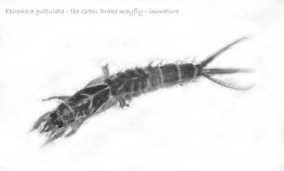
I have been fascinated by mayflies ever since I took a course in river ecology back in the 70’s and learned a bit about them and their biology.  Mayflies are aquatic insects, which means they live most of their lives in the water. 

Ephemera guttulata mayfly nymph small

Eventually the immature, water-dwelling  form (the nymph, which has gills and breathes underwater) hatches into a flying adult.  The adults live only a few days, and in fact have no functional mouth parts, so they cannot eat – they live just long enough to mate and they die soon afterwards.  Thus the scientific name for mayflies: insect order “Ephemeroptera,” which has the same Greek root as “ephemera” – literally, “for a day.” 

Because of this very short-lived adult stage, individuals of a given species of mayflies will tend to hatch nearly simultaneously and to emerge in huge swarms.  People who live near lakes or rivers with abundant mayfly populations often have to sweep mayflies off their porches.  These insects also mate in swarms, flying out over the water, mating in an aerial orgy, laying eggs and falling onto the surface of the water to die.  Needless to say, fish love this, and it is mayflies that fly fishermen often use as patterns for their artificial flies.

Ephemera guttulata mayfly

Adult mayflies have more or less triangular shaped front wings, very small hind wings, and two long filaments, called cerci, trailing from their abdomen.  They are not long distance fliers, but can hover and seem to dance over the water.  Their wings and manner of flying are fitted well to their fairy-tale lifestyle.

But these short-lived insects have been for around a long time – Protereisma directum is a mayfly ancestor that lived in the Permian (more than a quarter-billion years ago) of central Oklahoma.  Here is a photo of the fossil of the front wing of this species of fossil mayfly. 

P directum and penny

Back then, adult mayflies did have working mouthparts, so they might have lived longer than their descendents of today, but would still have been fairly short-lived.  Their front and hind wings were almost the same size and shape, so they likely could fly more slowly than today’s mayflies.  They did have those long filamentous cerci also. 

I find it endlessly ironic that insects like these, only hours in the air in their short lives, have flown year after year for hundreds of millions of years, reproducing and evolving and attaining their own kind of longevity, their own permanent sort of impermanence.  Here in this imprint of the wing of a tiny insect that flew for a only a few days 275 million years in the past, there is much for us to marvel at and ponder.  Ephemera, indeed!

– Roy Beckemeyer

The Book

Well, life on Earth would be much less meaningful to me without books.  So what better way to begin this blog than to acknowledge a wonderful paean to words printed on paper pages and bound into that wonderful artifact of civilization – the book.  Produced by the Eighth Day Institute in Wichita, Kansas, and titled “The Book by Synaxis n. a periodical gathering,” this periodical paperback (Volume 1, Number 1, Winter, 2012) was designed and edited by Erin Doom.  It is a unique and thought provoking assesssment and celebration of books and the role they play in our lives in this digital age.  It’s eight chapters are titled:

  • “Why Bother with Books?”
  • “What is a Book?”
  • “The Books of My Life”
  • The Fate of the Book”
  • “On the Reading of Theological Books”
  • Children’s Classics & Orthodox Spirituality”
  • “The Whole Book”
  • “The Pixel Became Flesh”

To quote the editor, each chapter is “… presented in the form of a triplet: an opening poem, a supplemental piece, and a prinary article.”  The chapters are really quite well put together and the pieces complement one another very well.  For example, the first chapter begins with a poem by Polish poet Czeslaw Milosz entitled “And Yet the Books,” a reminder that books will very likely be around much longer than any of the individuals who read them.  Next is an extract from Plato’s Phaedrus, which is followed by an extraordinary essay by Warren Farha with the same title as the chapter: “Why Bother with Books?”  It would be worthwhile to buy this book for this article alone, but the book is of consistently high quality, and there are many more memorable thoughts to be found here.

Although this is a periodical, “… each issue of Synaxis  is intended to look, feel, and function like a book.”  The editor notes that “… each issue…will focus on a theme of enduring relevance.  This inaugural issue focuses on ‘the book.’ The physical book increasingly finds itself neglected…”  He also says that “…each issue…strives to initiate dialogue by prompting a multitude of questions.”

I highly encourage every bibliophile to get on the Eighth Day Institute’s web site and order a copy of this first issue of Synaxis.  Even though the institute itself is affiliated with Orthodox Christianity, and promotes “renewing culture through faith and learning,” there is much here for readers of any religious or philosophical bent.  This issue of Synaxis meets its goal of promoting the “renewal of culture through literature and book reviews,” in a grand and eloquent fashion. 

– Roy Beckemeyer