Photo from a point about halfway (age 43 or so) through my life (early to mid-1980s). Here I am (top row, right) in my role as chief engineer on a robotic air vehicle (we’d call it a drone today) program at a remote test site in the western U.S. We had shop mechanics, test group, engineering, transportation, and program management folks at the site. This was my first important job as chief engineer of a program. Prior to this I had been managing and coordinating company-funded engineering R&D for the technical staff (which included all the basic technologies for military aircraft of the era: aerodynamics, structures, propulsion, avionics, human factors, flight controls, software development, etc.). This program management job led me into executive management as Director of Technology a few years later, and thence on to a nice variety of military and commercial airplane executive management positions.
This program was the kind in which I could not tell Pat where I was going or what I was doing, so we weren’t real happy with the situation as it affected our life together. Things got easier once I moved up the chain of command; the hours and days got no shorter but at least we could talk about what I was working on.
Tuesday November 25, 2025. I am 84 years old today. I was born on Tuesday, Nov. 25, 1941. There seems to be a certain symmetry about that. Born 9 years before the middle of the 20th Century, living now, 25 years before the middle of the 21st Century.
The weather for the day of my birth (in St. Louis, Missouri, the nearest city to Breese, Illinois) was high of 54, low of 27. There had been 2.3 inches of snow on the 22nd, 3.0 inches on the 23rd. So I expect my parents had made the trip to the hospital in Breese through snow, which would have melted some during the day. It had been 15 degrees the night of the 24th. The weather forecast for today in Wichita, Kansas, is a high of 57 degrees, low tonight of 29 degrees (there’s that symmetry again). No snow, here at all yet this year, though.
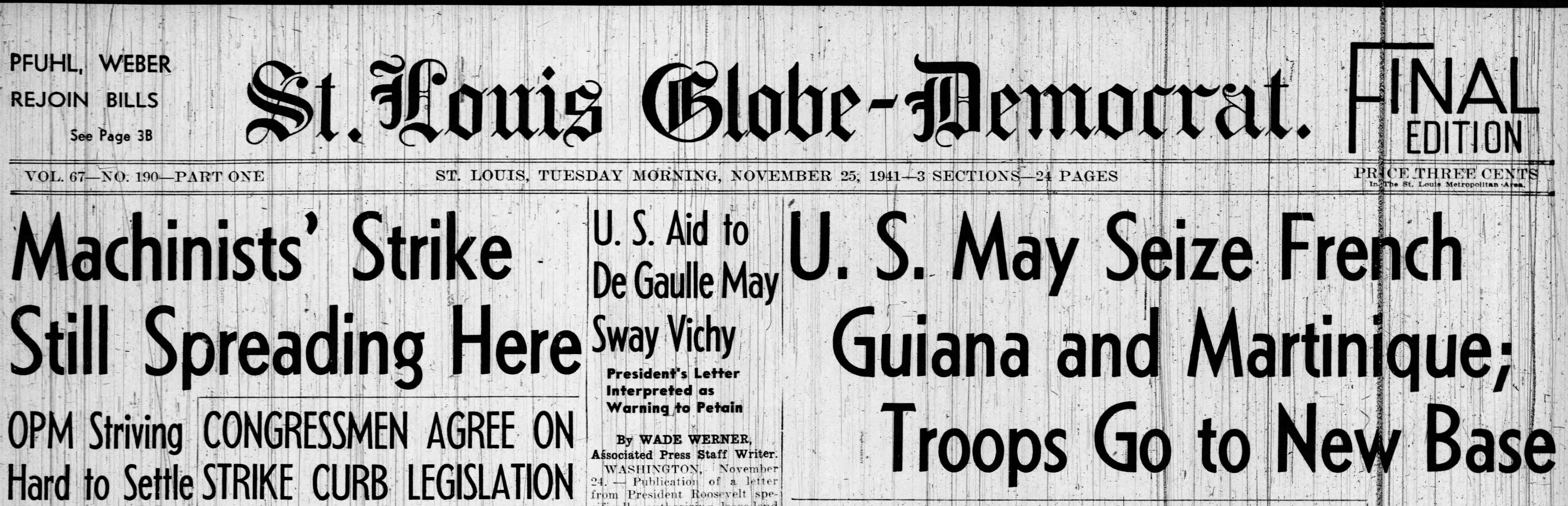
The headline for the day of my birth in the St. Louis Globe-Democrat (the morning paper for St. Louis; the evening paper was the St. Louis Post-Dispatch): “U.S. May Seize French Guiana and Martinique; Troops Go to New Base: Roosevelt Orders Dutch Colony Guard.” Dutch Guiana (Now Surinam) was just east of Venezuela, and French Guiana was east of Dutch Guiana. The Netherlands had been overrun by Nazi Germany, and U.S. troops had been sent to Dutch Guiana with the cooperation of the Netherlands government in exile on November 23rd, primarily because that country supplied 60% of the bauxite used by the United States in the manufacture of aluminum, which was needed for the production of airplanes.
Of course, today we have a U. S. Navy fleet just off the coast of Venezuela with the Trump Administration considering a troop incursion onto Venezuelan soil. No Nazis today, just drug runners. Another example of a “sort-of” symmetry, I suppose. (We were still 12 days short of entering the War on my birth date; the U. S. unsuspecting of the Japanese attack on Pearl Harbor that loomed on the horizon.)
The Supreme Court on Nov. 24, 1941 had “laid down the doctrine today that relief to the needy and interstate migration are matters of national concern and struck down an effort by California to deal independently with the problem.” “The court held unconstitutional a so-called ‘anti-Okie law, which made it a misdemeanor to help an indigent of another state to enter California…”
So that is an interesting sort of topsy-turvy inversion of symmetry between 1941 and 2025.
Where is all this going? I don’t know, just pondering what it feels like to have spent 84 years on this old earth, I suppose.
Pat Beckemeyer in front of a poster at the Denver Art Museum’s unique and special exhibit, “Becoming Van Gogh,” which was shown only this one time period, 21 October 2012 through 20 January 2013. I took this photo on 14 November 2012. We traveled to Denver specifically to see this show back when we had just begun to seriously study van Gogh and his work. I am really glad we did, because it was eye-opening, introducing us to van Gogh’s early work and explicating quite well how hard he had worked at the crafts of drawing and painting as he went along. It also made me aware for the first time of the wealth of information documented in his letters.
Now, of course, it is much too late for anyone to experience this one-of-a-kind exhibit, but I decided to gather here links to some of the documentation that is available online and elsewhere that can give you a feel for what it was like.
“Becoming Van Gogh” was the brainchild of Timothy Sandring, who was then Curator of the Denver Art Museum (now Curator Emeritus). He assembled (on loan – at that time the Denver Art Museum had no van Gogh works in its holdings) 70 examples of van Gogh’s work along with 20 examples of the work of some of those artists who influenced his development.
A fine place to start is with a short (6 minute) segment prepared by Rocky Mountain PBS at the time of the exhibit: ARTS DISTRICT: BECOMING VAN GOGH. I particularly like this introduction because in it Timothy Sandring talks about the importance of van Gogh’s letters in understanding his art and his development as an artist. Here are some quotes as I transcribed them as he talked (these words occur near the end of the video segment):
“It’s unquestionable that he [van Gogh] really strove to express feeling. And even in his letters he underlined words, he put them in bold, he put them in cursive, he was mark making so that you could feel the inflection that he would give to his voice…Some of the passages are the most beautiful descriptions of feelings about the liquidity of something such as boats on a sea or grasses or a pair of boots. They’re turgid in the writing — it’s not mellifluous — they’re not the kind of letters that you can keep plowing through — so you have to take them in piecemeal, very much, I think, like these paintings…I’ve learned to admire him greatly. He’s fiercely intelligent. He spoke four languages, he was a voracious reader, he was an associative thinker, he was a poet. In fact, his letters could be considered European literature.” ~Timothy Sandring
Here is a link to a webpage of the Denver Art Museum that outlines the exhibit’s structure and includes a nice photo of the entrance to the exhibit: VAN GOGH’s CREATIVE PROCESS (by Christin Bonk Fong). And here is another of the museum’s web pages that records 20 of the quotes from van Gogh’s letters that were used as labels for pieces of art in the exhibit and in the audio guides viewers could use: 20 QUOTES FROM VINCENT VAN GOGH (by Fairlight Baer-Gutierrez). The painting used as background for these labels was “Edge of a Wheat Field with Poppies” (1887), which at the time of the exhibit was in a private collection (the Frederic C. Hamilton Collection). The painting was gifted to the museum’s holdings in 2021, and can be seen on their web page.
I hope you enjoy this excursion back in time to a unique and impressive exhibit on how Vincent van Gogh became the artist we know today.
~Roy Beckemeyer, 10 October, 2023. [I recently took a thoroughly enjoyable and instructive online continuing education class from Wichita State University, “The Life and Work of Vincent van Goghn ” taught by Dan Kirchhefer, an artist who is also emeritus Professor of Art at Emporia State University. It got me re-energized about van Gogh, and sent me back to look up info on the Denver exhibit. Thanks, Dan.]
Here’s a stack of books – one small stack amidst bookcase after bookcase, stack after stack of books. These are in this stack because I have been into them, reading or rereading, browsing or devouring. Some are old friends, others unopened until now. I thought I would take this picture, then take up each book in hand and excerpt some snippets that I particularly like to share with you. Who knows, perhaps you will get interested, search for the book in your local library or online or in your favorite bookstore, pick up a copy, get infatuated with the author’s style or substance, maybe even go on a treasure hunt for more of their work. Stranger things have undoubtedly happened.
So here goes. Let’s begin with the top of the stack. Waiting on the Sky: More Flyover People Essays (Quincy Press, 2014), by Cheryl Unruh of Emporia, Kansas, is a book I bought from Cheryl herself at the 2015 Kansas Book Festival. It had won a 2015 Notable Book Award, as had my first book of poetry. I was familiar with Cheryl’s writing as I had read her first book, Flyover People: Life on the Ground ina Rectangular State (Quincy Press, 2011), which had also been a Kansas Notable Book awardee. Both books were based on weekly columns, titled (you might have guessed) “Flyover People,” that had appeared in The Emporia Gazette (yes, that famed newspaper).
Both of these books celebrate Kansas and the prairie and their denizens in fine style. I’ll let her speak for herself. If you’ve never experienced life on the prairie, she’ll give you a feel for why you would be hard pressed to find a way to wrench many of us from this big-sky country. But here, I’ll give Cheryl the floor:
From “Positives and Negatives” (January 2009):
“While other states are cluttered with forests or mountains or major metropolitan areas, we are blessed with a Zen-like landscape, the prairie.
…Yes less is more. We value our negative space.
In art, negative space is that part of a photograph or painting that is not the center of attention. Negative space is silence, background, an empty place where your eyes can rest. You may feel peaceful while gazing toward a grassy pasture, or you can rest your eyes upon the sky, that claming blue presence with its free-range clouds.
Here, we have the Flint Hills, a restful place for the soul, an open sanctuary in which the sky is our prayer book, the wind our hymnal.
After dark, we step into a cave of stars. In the big ol’ night sky, we draw our own constellations. We connect the dots, creating a Native American warrior or maybe a fearsome John Brown.
With our heads leaned back, we can count white lights till we’re dizzy. Out on the grassland we can almost hear the twinkling of those stars.”
From “At Home in the Flint Hills” (November, 2013):
“It’s quiet on the prairie, but not always silent. Insects and birds chatter. Some days there’s a growl of wind as gusts sweep the prairie without regard for man or beast. Wind can spin like a dervish, or it can ride low and slow and straight over the grasses, playing them like flutes.
A herd of bison lives on the preserve. Bulky and brown, they stand still like paperweights, holding down the prairie on those windy days.
The treeless landscape is one hill folding into another, bodies of hills lying together. We make our own shadows here, unless a cloud runs interference with the sun.
As a hawk glides overhead, we feel the rhythms of land and sky. Here, we step into that space between questions and answers, a place where we are satisfied with the unknown.
After dark the wind settles down, and the Milky Way flings itself across the sky. A rumor of coyotes hangs in the night air.”
From “Sunset Alert” (November, 2010):
“My friend Janet Fish, of Madison, paid close attention to sunsets when she and her husband, Larry, lived in Emporia. She said, ‘There were late afternoons when Larry would zip in and holler sunset alert and we’d stand in the yard and watch with our arms around each other.’
Janet said that from their location the color in the sky would glow behind the steeple of Sacred Heart Church. ‘Some nights it was so stunning that it would bring tears to our eyes.’
Janet has suggested a neighborhood notification system, church bells perhaps, something that would get our attention and send us all out into our yards to take in the show.
…
Our lives would be richer, wouldn’t they, if we each spent one minute a day watching the sky fill with flaming color. I can picture it now in every Kansas town: yards, sidewalks and driveways filling with neighbors, heads raised, eyes to the western sky, absorbing that moment of splendor. Let’s do it. I’ll meet you outside tonight.”
______________________
Okay, there you have an appetizer of Cheryl’s way with words. No full meal for you today. Rather, look for a copy of your own, and then you can nibble or pig out to your heart’s delight.
And watch for the next entry in this sampling of writing from my stack of books.
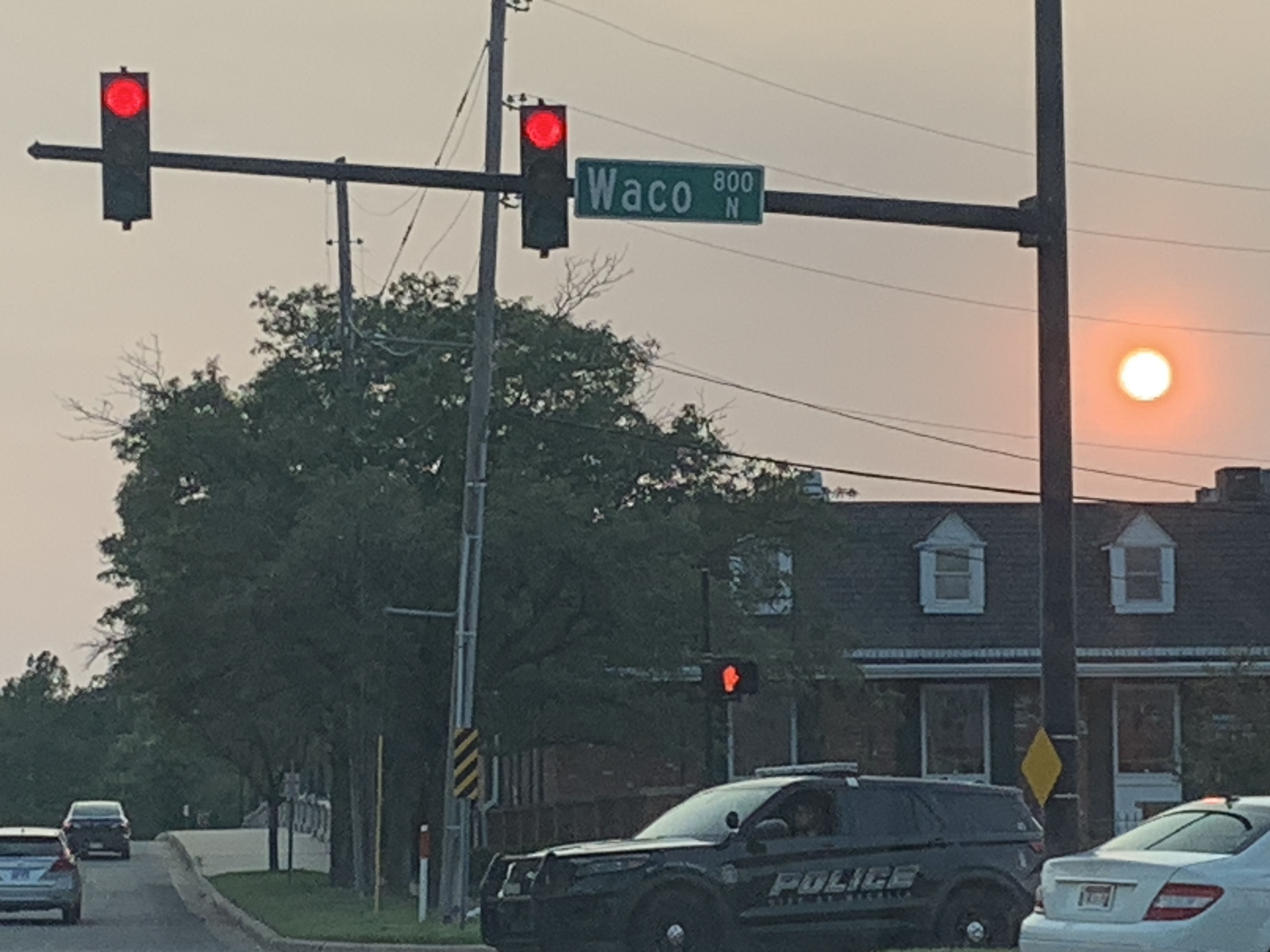
STOP, the sun says, ruddy-faced in a sky scorched by the desolation of a hundred million acres of wildfires. It’s not just pique, you know. That’s not an armful of ash graying the sky, it’s an inundation, an avalanche of carbon-dioxide poisoning burying us all. It’s climate-perversion wreaked on coming generations by ours. It’s our childrens’ world crumbling around them as we sit at our hundred thousand stop lights, our hundred million exhausts huffing into the dulling evening air.
~Roy Beckemeyer, August, 2023
This poem was inspired one evening as I drove home from the hospital where my wife Pat was battling pneumonia. I pulled up to this stop sign and the wildfire smoke in the upper atmosphere had made the sun appear reddish-orange and the first thing I thought was it looked very much like the stop lights. I clicked off a couple of quick cell phone shots through my windshield and drove on. Perusing the picture later, already in a somber mood because of Pat’s illness, this poem came to life. Pat is home now and recovering with the help of in-home nursing and physical and occupational therapists.
On May 20-22, 2013, an international meeting devoted to all aspects of Carboniferous-Permian geology with special emphasis on the Carboniferous-Permian transition was hosted by the New Mexico Museum of Natural History and Science, Albuquerque, New Mexico. At that meeting, I presented a paper entitled “A NEW SPECIES OF GLAPHYROPHLEBIA HANDLIRSCH, 1906 (INSECTA: NEOPTERA: BLATTINOPSIDAE) FROM THE LOWER PERMIAN WELLINGTON FORMATION OF NOBLE COUNTY, OKLAHOMA, USA.” In it, I described a new species of fossil insect which I named Glaphyrophlebia anderhalterorum in honor of my grandmother, Katherine Anderhalter and my uncle, her only son, Prof. Dr. Oliver Anderhalter.
The fossil is a spectacular one, with much of the body as well as the forewings preserved exceptionally well for a Wellington Formation insect. The insect’s wing color pattern is preserved on one half of the fossil, the other half comprising an impression of the wing and body.
The species name “anderhalterorum” is a “patronymic,” that is, it is chosen to honor a person or persons. The suffix “-orum” is used behind the name to indicate that more than one person is honored. Here is the text of the Etymology section of the paper, which gives the origin of the name chosen:
“Etymology: The specific epithet anderhalterorum honors my maternal grandmother, the late Katherine Vollet Anderhalter, and her son, the late Prof. Dr. Oliver Anderhalter. My grandmother encouraged me from my earliest school days to excel academically so that I might follow in my uncle’s footsteps and earn a PhD. Her expectations and his example nurtured in me an early interest in science and learning that has lasted a lifetime.”
Here is a color image of the fossil:
And her is a link to a pdf file of the full paper:
Oh, and the blue sage is in bloom today, Salvia azurea scattered across the prairie Like shards of sky, The petals the color Pachelbel’s Canon would be If you could see music with your eyes.
I noticed that its flowers have the same blue glow That Rublev used for the cloaks Of the three wanderers in his Trinity icon. Remember when we saw it in the Tretyakov Gallery?
He painted it 600 years ago With pigment ground from lapis lazuli From the Kokcha Valley, And you said that he had captured The blue of an Archangel’s eyes in those cloaks.
Can you picture how his icon must have stood out Like a blue beacon against the towering gold and red Iconostasis of the Trinity Monastery?
The blue beacons of sage are angels today, blessing These wide tawny fields of gold-leafed Indian grass With their singularly azure essence of blue.
~Roy Beckemeyer, 2011, revised 2023.
My wife, Pat, and I were fortunate to see this icon on our visit to the Tretyakov Gallery in Moscow. It had resided there from the 1918-9 restoration, which first revealed something of the artistry of Rublev’s original work, until July 2022, when it was returned to the Trinity Lavra of St. Sergius, where it had originally resided. On previous returns of the icon to that monastery, exposure to the uncontrolled humidity and temperature and to the candle smoke and incense had caused the icon to deteriorate. It has apparently been returned to the Tretyakov, but there may have been some deterioration and it may not be available for viewing for some time.
My new book, The Currency of His Light (Turning Plow Press, 2023) takes its title from my poem of the same name, which originally appeared in the online journal, The Ekphrastic Review, on November 23, 2020.
The poem was inspired by impressionist painter Claude Monet’s series of paintings, “The Houses of Parliament,” which were painted between 1900, when Monet was in London, and 1905, when he completed the series in his studio in Giverny, France.
Monet was attempting to capture the fleeting variations of light in the foggy, smoggy atmosphere of turn of the nineteenth Century London. In a letter to his wife dated Sunday 18 March 1900, he wrote:
‘Today was a day of terrible struggle, and it will be the same until I leave. Only I need more canvases: there’s no other way to get anything done, than to have different ones going for all kinds of weather, all kinds of harmonies, that’s the real way to do it and, at the beginning, one always expects to find the same effects again and finish them: that’s what leads to these dreadful transformations that are worse than useless.
‘As you see, it’s not enthusiasm that I lack, for I have something like 65 canvases covered with colour and I still need more, this country is something quite out of the ordinary: so I shall have to order more canvases. What a bill I’m going to have from Lechertier’s!’
During the time I was writing this poem, I also had been reading John Milton’s poem, “On His Blindness,” and was captivated by the line “When I consider how my light is spent…” That line, and Monet’s hours spent trying to capture elusive light on canvas made me think of time as a sort of currency (the only real currency any of us have to spend), and of his producing his paintings as investing in another medium of currency, as if he might be coining his own “currency”; hence the title.
I hope you enjoy this video. Roy Beckemeyer, 03-23-2023:
Roy Beckemeyer reading his poem, “The Currency of His Light” accompanied by background images of paintings from the series “The Houses of Parliament,” (Claude Monet, 1900-1905).
My poem, “Hummingbirds” can be found on p. 8 of my new book, The Currency of His Light (Turning Plow Press, 2023). The poem was inspired by my many years of observation of hummingbirds as an avid bird watcher, and by the last lines of Jane Kenyon’s poem, “Year Day,” which I used as an epigraph: “Here are the gestures / of my hands. Wear them in your hair.” The poem contains allusions to pop-culture stop-motion animation as well as to the classic 1930 Marlene Dietrich movie “The Blue Angel.”
Here is a link to “Hummingbirds,” which first appeared in the online literary journal MacQueen’s Quinterley (Issue 11, January 2022).
And here is a link to Jane Kenyon’s poem, “Year Day.”
My latest poetry book, The Currency of His Light (Turning Plow Press, 2023) contains two short poems inspired by quotes from work by the two-time Texas Poet Laureate, Vassar Miller (1924-1998). I suspect quite a few readers will not be familiar with Miller and her work, so thought that I should elaborate a bit here.
I own two (of her ten) books of poetry, Wage War on Silence (1960) and My Bones Being Wiser (1963), both put out by Wesleyan University Press. Both the epigraphs I used were from Wage War on Silence, which was a Pulitzer Prize nominee in 1961. The University of North Texas Press holds a yearly poetry book contest in Miller’s name. She lived in Houston all her life (she had cerebral palsy which made mobility and speech difficult), and she earned bachelor’s and master’s degrees from the University of Houston. She reviewed books for the Houston Post in the 1950s and 1960s, taught creative writing at the St. John’s School in Houston and was writer-in-residence at the University of St. Thomas. The short biography from which some of this information came may be found on the Texas State Historical Association website. She was inducted into the Texas Women’s Hall of Fame in 1996.
In Miller’s obituary in The New York Times (Nov. 8, 1998), Rick Lyman noted: “Many Texas writers and critics, most notably Larry McMurtry, lamented the lack of attention paid to her work, which had never been considered particularly fashionable until late in her career. ‘That she is to this day little known, read or praised in Texas is the most damning comment possible on our literary culture,’ he wrote in a 1981 essay in The Texas Observer.”
After McMurtry’s essay appeared, Miller was named Texas Poet Laureate in 1982 and again in 1988. Her collected papers, which include her correspondence with such luminaries as McMurtry, Richard Hugo, and James Wright, are in the Archives of the University of Houston.
A lovely memoir about Miller and her personality and work may be found in Jenni Simmons’ Curator Magazine article “She Spoke to Silence.”
Here is one of my two poems inspired by quotes from her work, after which I have added Vassar Miller’s poem, “Tree of Silence.” My epigraph is the first line of that poem.
Discourse
“Along the branches of our silence hang our words.” —Vassar Miller, “The Tree of Silence”
The words form, rounded as apples, as oblong pears suddenly succulent, the fleshy home of pips, of seedling insights, ideas of future generations of thoughts and proposals yet unsaid, but pregnant with years of considered cogitation to come, misunderstandings avoided, loves never lost, brilliant discourses instigated by foliferous buds, by orange leaves of words all strung, curled, intricately scalloped by the clenched teeth, the coiled tongue of silence.
By Roy Beckemeyer, from The Currency of His Light (Turning Plow Press, 2023), p. 102.
_____
“The Tree of Silence
(For Nancy)
Upon the branches of our silence hang our words, Half-ripened fruit. Gone are the months of summer, gone Beyond pursuit. Let us leave, though pinched and wan, The windfalls wither Under the tree whose shade affords No shelter either.
For when was language ever food for human yearning! Sun-gilded rain Mocking the sheen of golden peach, Words only drain Hearts of strength; let mortal speech Make time and way For life, the long and lonely yearning How to pray.”
By Vassar Miller, from Wage War on Silence (Wesleyan University Press, 1960), p. 51.
I sincerely hope that this piece encourages you to read more of my poetry, and more of Vassar Miller’s work as well. Please link to my author’s page for information on how to acquire a copy of The Currency of His Light (Turning Plow Press, 2023).